

On 18 July this year I sent a friend this message:
"I swear they've changed the way they pick the words. My method used to usually get them in 3 or 4… after 4 guesses even though I always eliminate 18 letters by then I'm left scratching my head. That used to be rare. Now it's basically every day."
I was, I'll admit, being a bit of a drama queen. Everyone who plays Wordle has a bad week and decides the game has turned against them. But the feeling didn't go away. By September I was at it again: "It used to almost always be a pretty common word… Now it's often some weird obscure thing that you'd totally be forgiven for not getting. Or even have heard of."
So I did what any reasonable person does with a nagging hunch and a love of data analysis. I spent far too long proving it.

My method, and why I thought it was bulletproof
I started playing in January 2022, at the height of the craze, and by March I'd settled on a system. As I put it at the time, with all the confidence of a man who'd been playing for ten weeks: "First word RAISE second word MOUNT. It's never let me down."
RAISE then MOUNT gets all five vowels and five of the most common consonants into play in two guesses. If that turned up next to nothing I'd follow with CHALK, and if still nothing, FUDGY. By then I've tried 18 of the 26 letters. In 2022 that felt close to unbeatable.
I played about 400 games between January 2022 and May 2023 and averaged 4.09 guesses. Then I stopped. When a friend asked if I'd given up, I told him: "I'm going Wordle dark."
I came back around the end of May this year. Within a few weeks the system that had "never let me down" was routinely leaving me stuck on guess five with most of the alphabet crossed off and no idea what the word was.
Didn't someone already check this?
Sort of, but a long time ago.
It helps to know how the answers were chosen in the first place. When Josh Wardle built Wordle for his partner, Palak Shah, it originally allowed every five-letter word in English, about 13,000 of them. She kept getting stuck on obscure ones, which made it feel like guessing rather than deducing. So she went through the list and picked out the words she knew. The answer list ended up at 2,315 words, about six years' worth at one a day. Wordle started in June 2021. You can probably see where this is going.
When the New York Times bought the game in early 2022, lots of people complained it had got harder, and several articles checked and found it hadn't. Tom's Guide went with "No, Wordle hasn't gotten harder since the NYT takeover, here's the proof". The NYT was still working through Wardle and Shah's list in order, minus a handful of words it removed for being offensive, obscure or, in the case of FIBRE, British 😡.
That was true then. But one person saw this coming. In February 2022 the data scientist Esteban Moro took the list of future answers, which at the time was sitting in the game's own code, ran the numbers all the way to 2027, and opened his post with a Back to the Future joke and a warning: "Wordle is getting harder. Not much, but harder." Wardle seemed to have front-loaded the common words.
A lot has changed since. In November 2022 the NYT appointed an editor, Tracy Bennett, to curate the answers. From 2023 she started adding words that weren't on the original list. And in February this year the NYT began repeating old answers, starting, rather sweetly, with CIGAR, the very first Wordle.
As far as I can find, nobody has gone back and measured whether the words themselves have changed since then. So I checked three things: the words, other players, and me.
1. The words are getting rarer
I took every Wordle answer from the first game in June 2021 to 2 October 2026, all 1,932 of them, and scored each one by how often it turns up in everyday English. The score comes from a widely used research tool called wordfreq, which pools word counts from Wikipedia, film and TV subtitles, news, books and social media. I double-checked it against Google's word counts from millions of books, and the two agree.
In Wordle's first two years about one answer in four was what I'd call a rare word. Over the last three months it's been more than one in three (24% against 36%). That's not a fluke of a few bad days. The gap holds over the last 3, 6 and 12 months, on both measures of word frequency, and it's statistically significant.
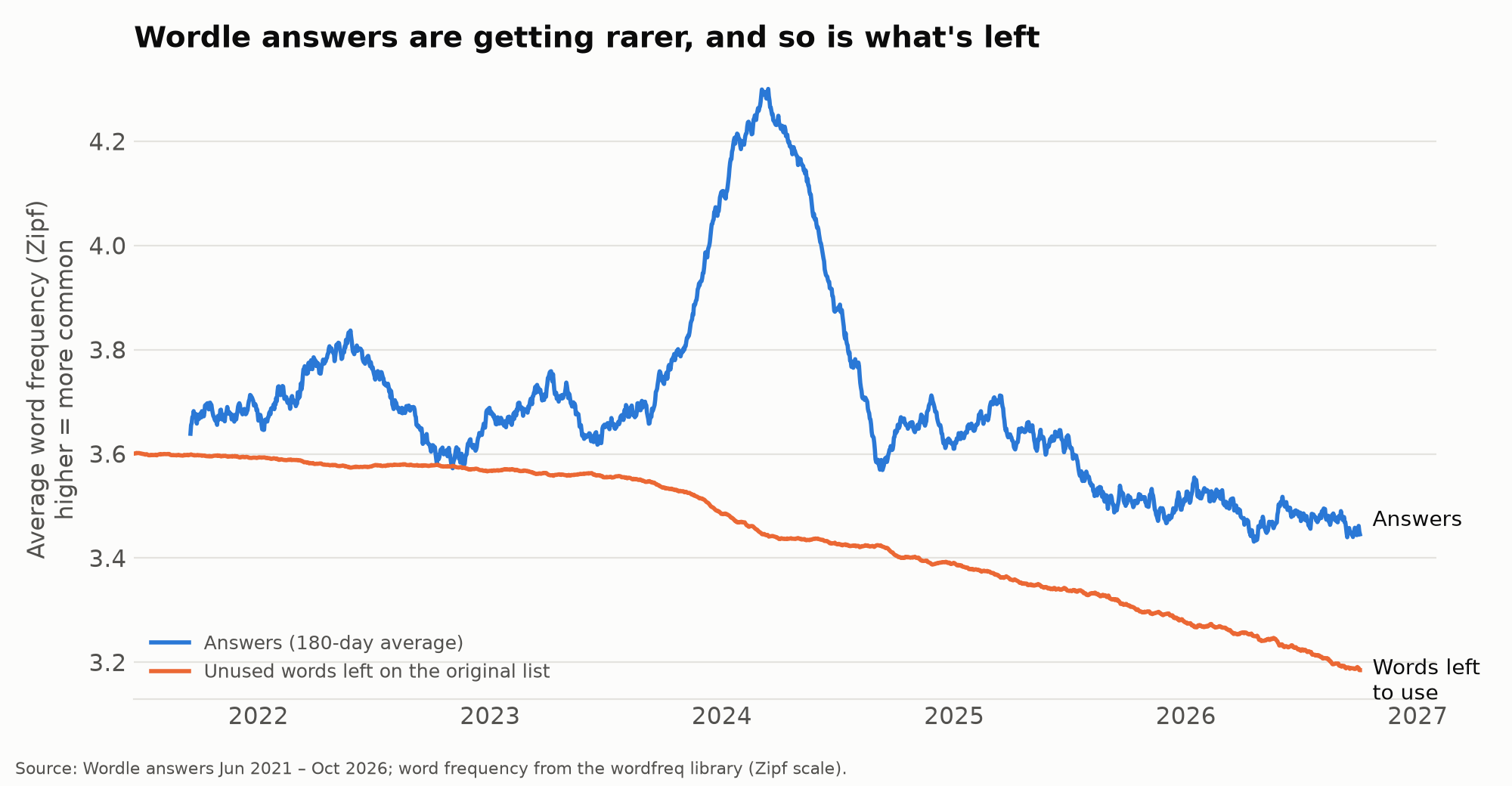
Here's the interesting bit, which is why. It isn't, mainly, that someone at the NYT is cackling while picking nasty words. Three things are going on.
The easy words are running out. Fewer than 500 of Wardle and Shah's 2,315 haven't been used yet. The orange line in the chart above shows how common those leftover words are on average, and it has been sliding steadily. The friendly words have mostly gone. What's left is the tail: the DEMURs, the UMBRAs and the COPSEs.
The odd thing is that the editor has, if anything, been kind. Bennett has said she picks words with a random number generator and then vets them, and since 2023 her picks have been slightly more common than the average of what was left. You can see that as the big easy bump in early 2024. But picking the easy ones first leaves the hard ones for later, and later is now.
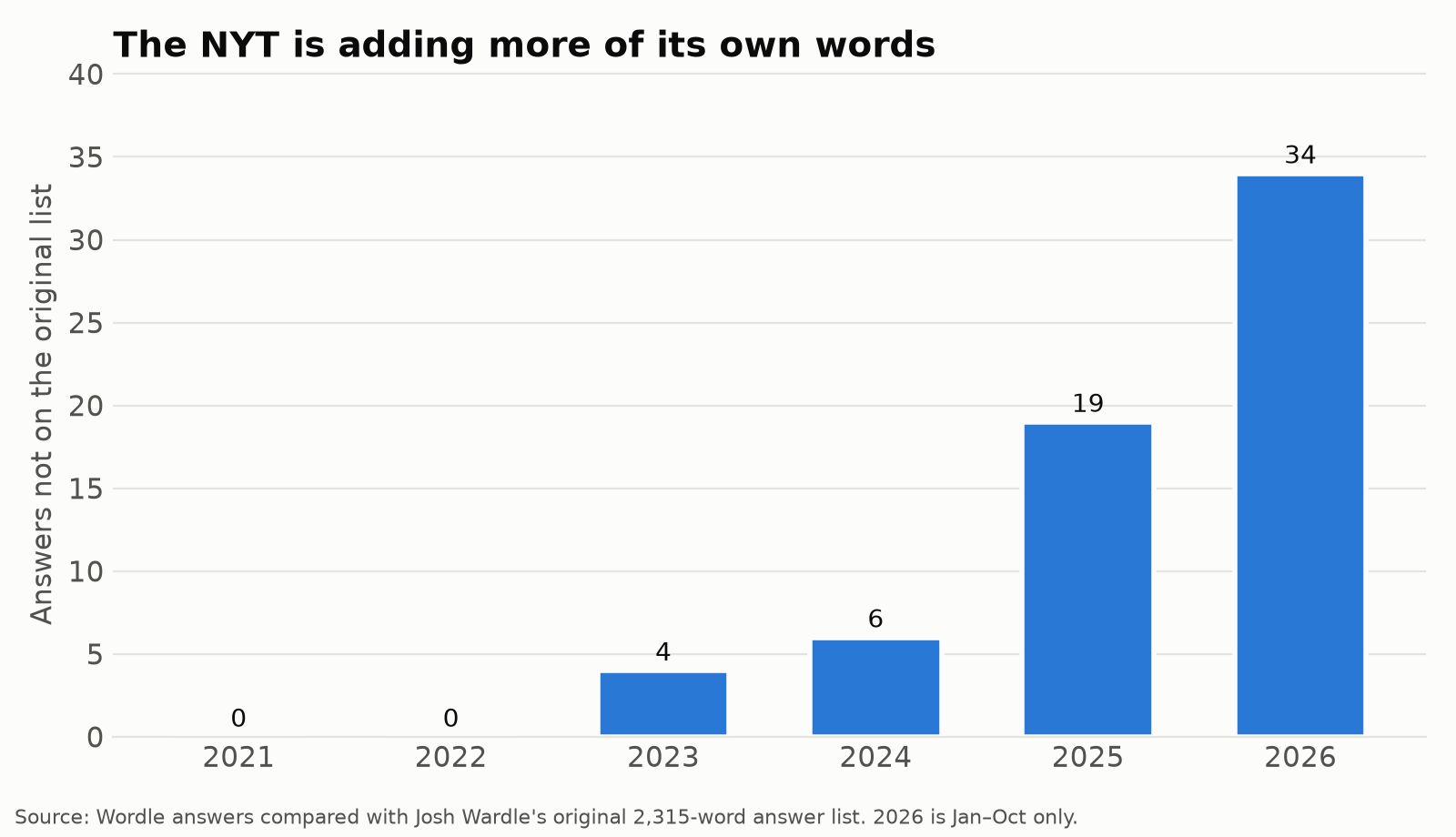
The NYT is adding its own words, and they're harder. 63 answers so far weren't on the original list, and the pace has picked up sharply: 4 in 2023, 6 in 2024, 19 in 2025 and 34 so far this year. Some are perfectly friendly, like LASER and MESSY. But there's also PSHAW, CAROM, GEODE, CUBIT, ASPIC and CAPON, and on average the additions are much rarer than the originals.
Repeats are papering over the cracks. Since February the NYT has re-run 25 old answers, and 21 of them are from Wordle's first few months in 2021, familiar ones like AWAKE and AGREE. They make the overall numbers look easier than they'd otherwise be, so if anything the figures above understate the shift.
2. Real players are struggling too
Rarer words are one thing, but do they actually make the game harder? Maybe nobody struggles with SPATE.
Luckily the NYT publishes how many guesses its players need every day through its WordleBot tool, and someone has been archiving those figures daily since March 2023. That's around 420,000 players a day.
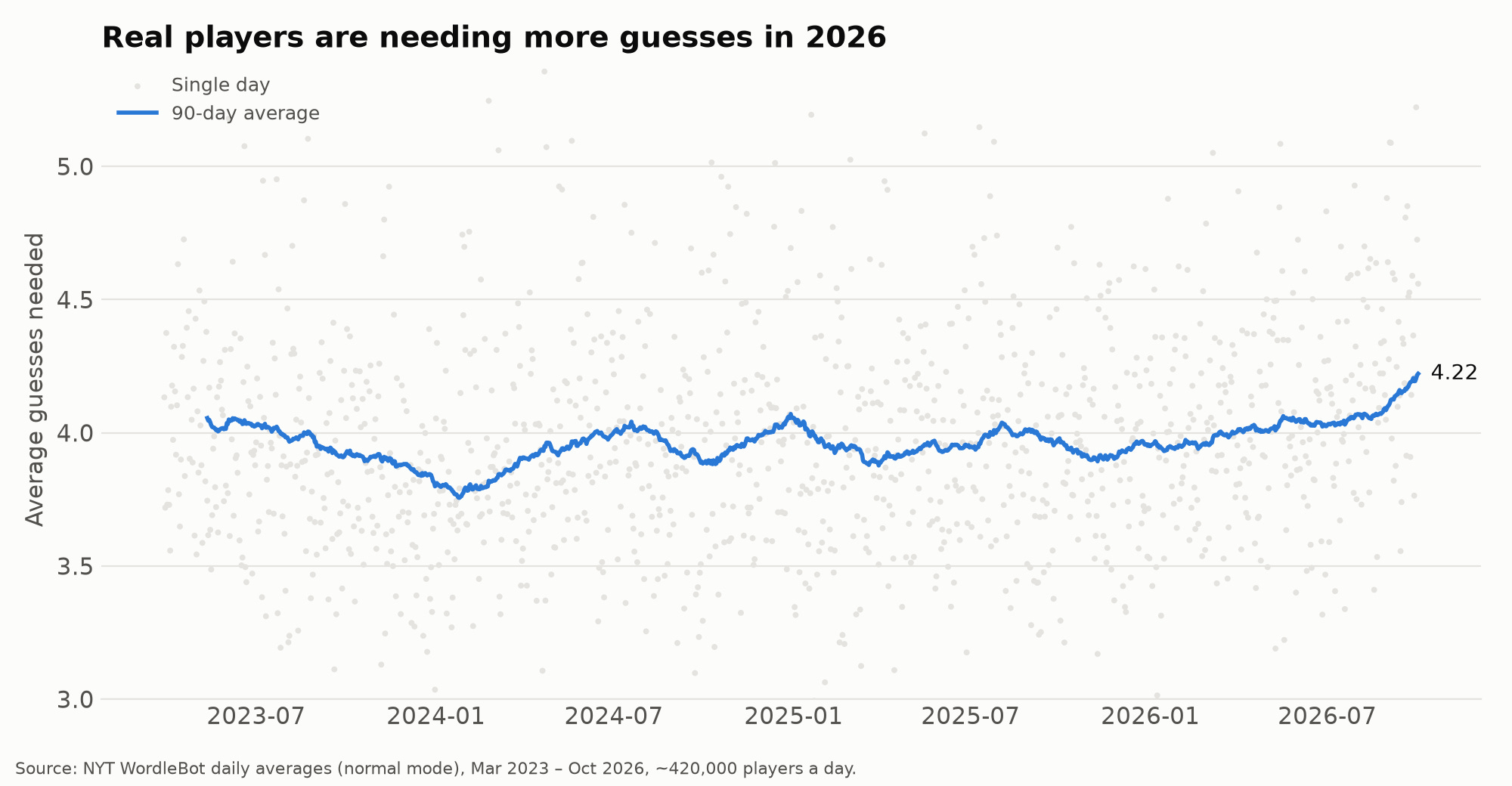
For the first few years of that record nothing much happened. 2023, 2024 and 2025 all averaged about 3.94 guesses. So if you've seen people say Wordle hasn't got harder, they weren't wrong at the time.
Then 2026 happened. The average over the last three months is 4.22 guesses, the highest for any three months in the record. In the first year of the data about one day in fourteen was a real stinker, where players averaged 4.5 guesses or more. In the last three months it's been one day in four. The share of people failing outright has doubled, from 1.5% to 3%. September 2026 was the hardest full month in the record, at 4.33. That beats July 2025, which TechRadar crowned "Wordle's toughest ever" at 4.22. Fittingly, that piece was written by Marc McLaren, who also wrote the 2022 Tom's Guide piece saying it hadn't got harder. He was right both times.
It's the words. Rarer words cost players more guesses, steadily, all the way down the scale.
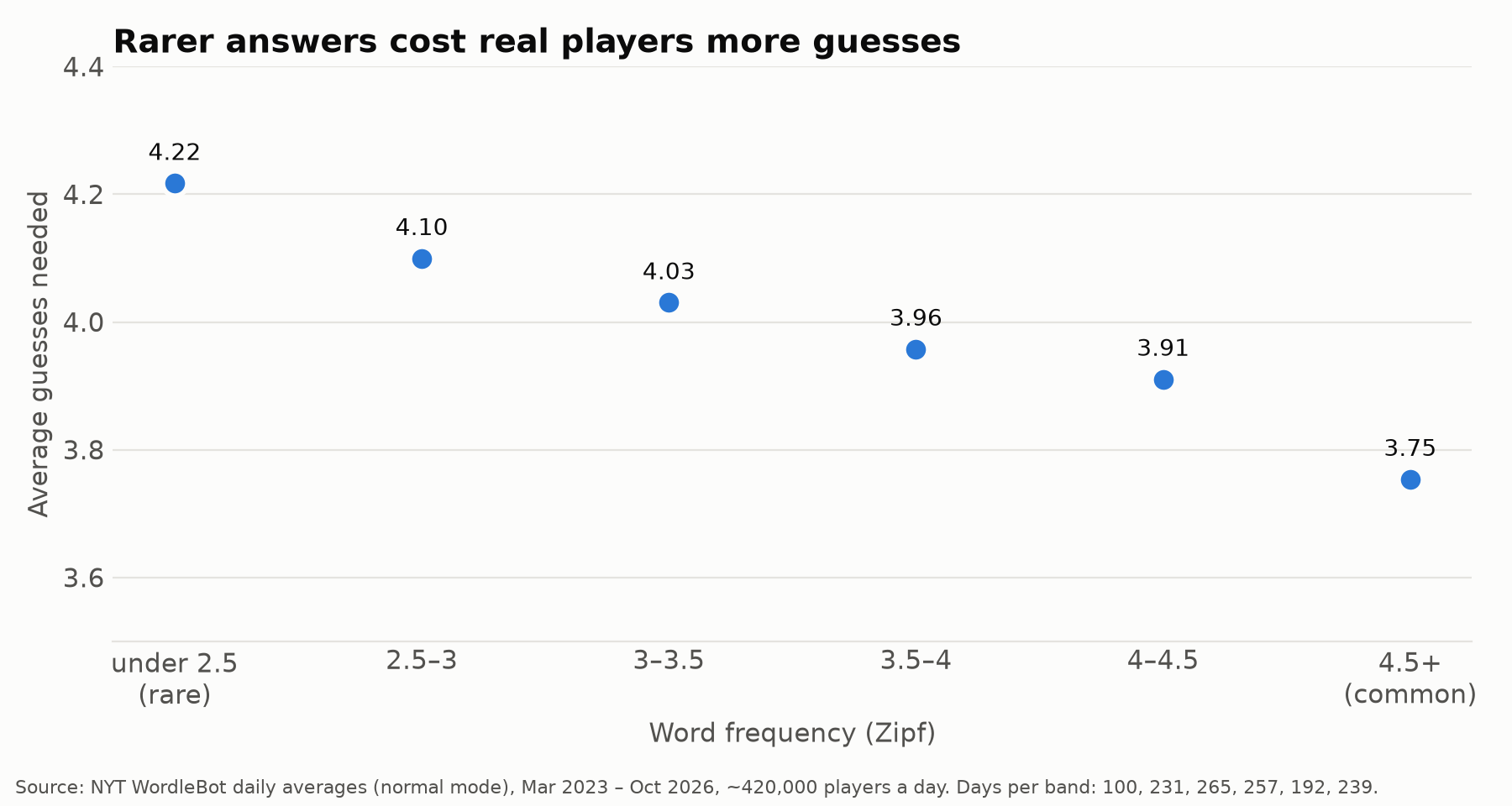
When I ran the numbers properly, three things about each word accounted for most of the rise: how rare it is, whether it has a repeated letter (nearly 38% of answers in the last six months, up from 27%), and whether it's one of the NYT's own additions. Once you allow for those there's no underlying upward drift left at all. Players haven't got worse. The words have got harder.
Rarity isn't the whole story, though. The hardest day of this year was RIVER, on 30 September, which is about as common as five-letter words get. Nearly 100,000 of the 430,000 WordleBot players failed to get it. Once you have _IVER you're choosing between DIVER, FIVER, GIVER, LIVER and RIVER, and nothing tells you which. Bennett knows all about that. Back in 2023 she told an interviewer she watches out for patterns like _OUND, because with found, mound, round, sound and the rest, getting it is "based on luck, rather than deduction". On 31 August the answer was MOUND. 18% of players failed.
3. And then there's me
The nice thing about having been insufferable about Wordle on Twitter and WhatsApp in 2022 is that there's a record. I dug out every score I shared: 400 games from 2022-23, and I've logged another 68 since coming back.
My average has gone from 4.09 to 4.28 guesses. On its own that could just be me getting rusty. But I can also check how hard the words I faced were, using a model that predicts the average player's score from the word itself. The words in my 2026 games are predicted to need about 0.15 more guesses than the ones I faced in 2022-23. My scores went up by about the same amount. Allow for the words and there's no sign I've got any worse. It's not me.
And that "scratching my head after four guesses" feeling? In 2022-23, 36% of my games needed five or more guesses. Since I came back it's 50%. So it isn't quite "basically every day". But it is literally every other day.
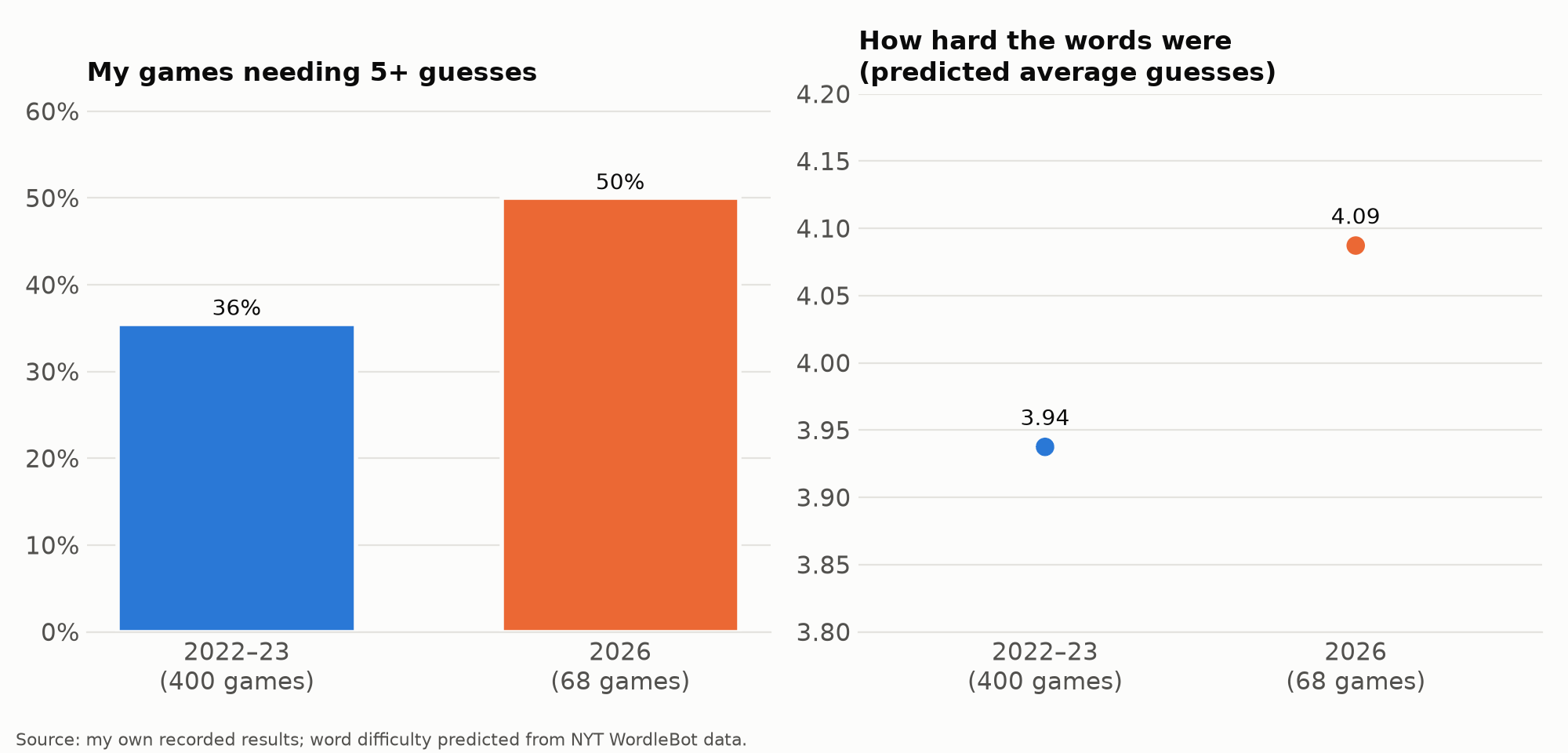
What surprised me is where the damage is done. I simulated my RAISE, MOUNT, CHALK, FUDGY system on every Wordle answer ever, and the openers are doing their job exactly as well as they always did. RAISE and MOUNT come back almost blank about a third of the time, then and now. The problem is what comes after. You can know most of the letters and still be stuck, because what's left is a word you'd never think of, or a choice between WAVER, WAGER and PAGER, or a double letter like PUFFY or DOWDY that the openers can't tell you about.
So what do I do now?
Lately I've been deliberately leaning into it. When the openers come back thin, I've stopped assuming the answer is a nice everyday word and started reaching for the strange ones much earlier. It feels like it's working, but I'll be honest, I don't have enough games yet to prove it. Ask me again in six months.
What I can say is this. If you've come back to Wordle, or you just feel it's got meaner, you're not imagining it. The answers really are rarer, real players really are needing more guesses, and it's because of the words, not because we've all got worse.
What I'm not saying
Because someone might ask:
I'm not saying the NYT is deliberately making Wordle harder. The main driver is the original list running out, which Esteban Moro spotted coming in 2022. The additions are a deliberate choice, but the editor's picks from the original list have leaned easier, not harder.
I'm not saying it will keep getting harder. Much of the 2026 jump comes from the last few months, including a brutal September (JOIST, WAGER, RIVER and, on the last day of August, MOUND). It might calm down. And the single worst day in the record is still CORER, in October 2024, when a third of players failed. What's changed is how often the bad days come round.
My own scores are one person's 68 recent games. They tell the same story as the big data, but they're not proof. That is the 420,000-a-day WordleBot numbers.
Word frequency isn't the same as difficulty, as RIVER shows, which is why I checked real players' results rather than relying on frequency alone.
How I did it
Every answer since June 2021 came from two independent public archives, which agree on every day, and I spot-checked 188 of them, including every NYT addition and every repeat, against the NYT's own site. Word frequency comes from the wordfreq library, cross-checked against Google Books. Real-player figures are the NYT's own WordleBot daily averages, March 2023 to October 2026, from the Wordle Charts archive. To compare against 2021-22, before that record starts, I used a model that predicts a word's difficulty from its features, and tested it against results players shared on Twitter in 2022, which it hadn't seen. It did a good job. My own scores come from what I shared at the time. I'm happy to share the data and code with anyone who wants to check my working.
Further reading
Wordle is getting (slightly) harder, Esteban Moro, February 2022
July was officially Wordle's toughest ever, but it could get harder still, TechRadar
Wordle Editor Tracy Bennett On The Most Difficult Words, Today
PSHAW was a real low point!
Tbh, I’m enjoying the way Wordle’s developing. Once you have a system the ”easy/common” words reveal quite simply. I enjoy the challenge the double letters and repeat vowels give me.
If it hadn’t changed then I’d probably have stopped. Relish the challenge - nothing good ever comes easily